-
Satan’s Altar
There is a lot of news coverage of the man who attacked Christian Messianic Jewish fiction writer, Jonathan Cahn on an airplane this week. There are some things that need to be said, lest we take this incident as proof of what Cahn’s fictional books propose. Those things do not line up with the biblical testimony, to which all of our faith convictions must align. – Donna Diorio
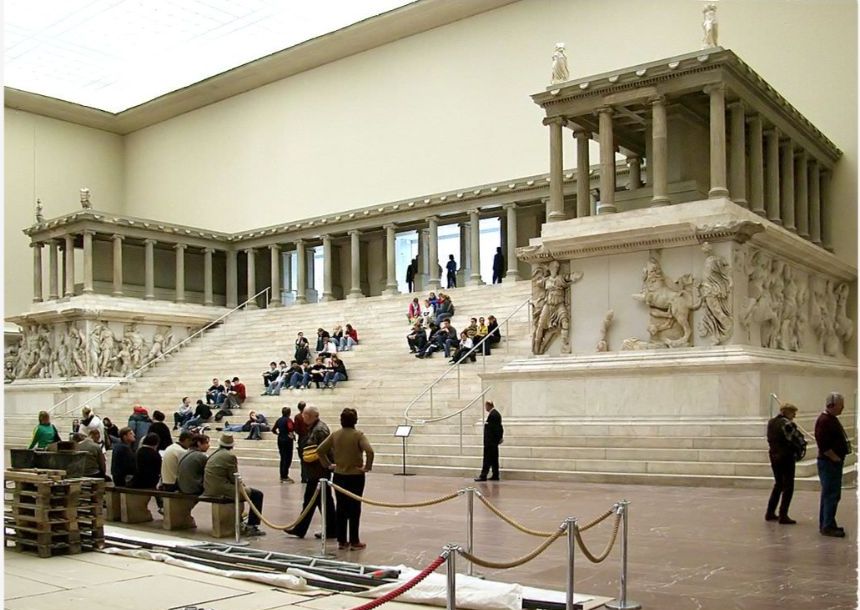
Excavated from a hillside in Turkey in 1870 and 1886 and shipped to Berlin, this large-scale
reproduction of the western facade stands in the Pergamon Museum. It uses a combination of original marble fragments and modern restorations. It was originally built in the first half of 2nd century BCE most likely 170 BCE. The monument consisted of a high U-shaped podium with a continuous high-relief frieze (the Giantomachy).
The Giantomachy was told to be a great and brutal war in Greek mythology between the Olympian gods battling giants. Some of the giants depicted with serpentine lower bodies. The original altar platform and some foundations remain on the hillside of Bergama, Turkey. The identification of this altar claimed by some to be the “throne of Satan” referred to in Revelation 2 is a popular but scholarly debated interpretation rather than a proven fact.
It is also known as the Great Altar of Zeus, a ‘god’ of Greek mythology.“I am the LORD/YHVH, and there is no other; there is no God but Me.
I will equip you for battle, though you have not known Me,
so that all may know, from where the sun rises to where it sets,
that there is none but Me; I am the LORD, and there is no other.”
Isaiah 45:5-6Sept 9, 2026: Satan sits on the throne of idolatry in the hearts of mankind and it is the demonic spirit of idolatry we are really dealing with both in America and throughout the world. Forget about the physical altar of Pergamos – it has no magical demonic powers attached to it. It is the demonic spirits controlling the hearts of human beings that is the spiritual warfare we fight.
It is the spirit of idolatry that expressed itself in ancient times as worship of mythological gods and goddesses that now expresses itself in a myriad of modern expressions from entertainment and sports stars to good old-fashioned greed for wealth.
It is the spirit of idolatry that the Revelation letter to Pergamus was addressing, not a geographical location.
The geographical location of the church in Pergamus was important only because it was the epicenter of Greek mythology. Even the name Pergamus is from Greek mythology because it was the name of a mythological son of a couple of mythological parents Neoptolemus and Andromache.