Misjudging Messianic Israel
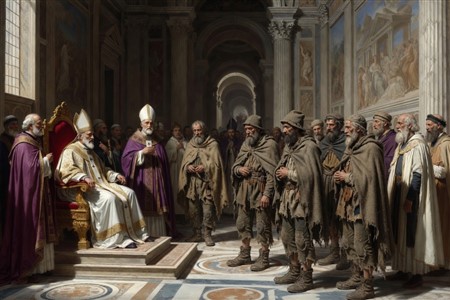
Malachi Martin in his 1983 book,
The Decline and Fall of the Roman Church.
Having followed the Israeli Messianic ministries closely for two and half decades, I have noticed something about Christian ministers, even some of the very best ministries who help people get free of the things that are strongholds. Freedom from the things of the past that have held us back, can keep us after coming to faith in sorrows, pain and lack. Jesus came to set the captives free. Absolutely. That is not a good explanation for how why Israeli Messianic believers suffer lack of adequate resources, or suffer along with their unsaved countrymen in the distresses of living as an Israeli.
Track with me as I lay down the breadcrumbs God has left for us in the Bible about these things.
My starting place is with Hannah being misjudged by the priest Eli when she was praying within herself at the altar: “In her bitter distress, Hannah prayed to the LORD and wept with many tears.” Then she made a vow to God that if He gave her a son, she would dedicate him to God for all his life.
Now the priest Eli is watching her crying her eyes out at the altar, wordlessly, and concluded she was drunk. He rebuked Hannah. It is easy to make snap judgments about people who are suffering in pain and sorrow. I think we have probably all done it at some point in our lives. But there is a greater spiritual principle being shown here, that I don’t want anyone to miss.
When Eli recognized his misjudgment of the cause of Hannah’s presence at the altar of God, he spoke healing words to her and over her: “Go in peace,” Eli replied, “and may the God of Israel grant the petition you have asked of Him.”
If you are a Christian, this is an account that is for you in relation to how you assess the Israeli body of Messiah.
Especially them, because many of them have been drawn to Israel on assignment from God for the purpose of what Romans 11 calls “all Israel shall be saved”. Many of them left far more comfortable living situations in the nations of their birth (the nations of their exile) to serve the LORD in their Promised Land. They made sacrifices to serve Israel’s Messiah among the people He promised to return to.
Hold that thought as I move to the next breadcrumb on your discovery trail. In 1 Corinthians 7, Paul addresses believers who are married to unbelievers. Anyone who has ever been in that position knows that heartaches lurk where there is “unequally yoked” partners. Yet, God forbids divorce in the New Covenant except for adultery, which is not the only heartache marriage partners come up against.
Divorce was permitted in the Mosaic covenant but not in the covenant Jesus cut with us. The reason is because the indwelling spirit gives us the overcoming power to stand in an even extremely close relationship with an unbeliever . . . and all the pains and sorrows that entails.
Do not think for a minute I am proposing staying in a life-threatening physical abuse situation. Believers have divorced over much less than that extreme!
But what does Paul advise in verses 12-16: If a man or a woman is married to an unbeliever who is “willing” to live with the believer, the believer should not leave the marriage. The believer is not to divorce the unbeliever, but to remain because the unbelieving spouse is sanctified by the believing spouse.
That word for “sanctified” means to be consecrated, or dedicated to God; to render or to separate from profane things and dedicate to God.” Does that mean the unbeliever no longer sins? No it doesn’t, but it means the believer has put a higher claim on the unbeliever’s life than even the unbeliever has put on their own life. It is a sacrificial act unto God for that spouse that also impacts any children within the marriage. As Paul said, “Otherwise your children would be unclean, but now they are holy.”
So can you see the parallels I’m referring to here? I have found that many Christian ministers have looked down their noses at the Messianic Jewish ministries, much like the priest Eli looked at Hannah. Many Christian ministers see the lack of financial resources of the Israeli Messianic ministries as indication that something is ‘off’ in their ministries. That their faith is falling behind in some way. Must be legalism, right? You really don’t know them, those you judge in this way.
Also the messy human emotions of being a Jew living in Israel where war, terrorism and death is constantly against them from their neighbors. Where the hatred from the nations is also a constant since the spiritual rebirth (resurrection, restoration – you choose the word, they are all appropriate) of the State of Israel in 1948.
Honestly, how could any Christian minister imagine that if they were standing in such a place for the salvation of their nation before God, that it would not look messy emotionally to the natural eye? I am inviting you to drop that uninformed, unspiritual assessment of the Israeli Messianic ministries and to see them through the eyes of the Spirit of God. They are exactly like the believer spouse who is sanctifying the unbelieving spouse. They are standing as Jews whose faith is in Yeshua in the most difficult of possible life situations in the world.
And you are judging them because you think true anointed ministries are always able to raise financial support to sustain the ministry? Is your measuring stick how Christian ministries in Western nations are measured? Or, maybe you are judging them because of how even in their earnest faith and hope in the Messiah Yeshua, they still suffer periods of human distress as the rest of their nation while being pummeled by rockets, attacked by terrorists, with family members standing in harm’s way to defend against the relentless enemies of Islam? You are judging them for the pain and sorrows they share with their natural family, the Jews of Israel, when loved ones are wounded or killed?
You know when believers sit in the seat of judgment against other believers enduring a life “as unto the LORD” for the sake of the salvation of their families, whether immediate natural families or the whole state of Israel, that is a sad comment. The sacrifice is unto God.
We must enter into a spiritual vision for what our Israeli brothers and sisters in the Lord are actually standing in and why. They are voluntarily standing in that place, laying down their lives for what God wants to do to restore His family in Israel. Until we see that, we will be of no use to bringing those who live sacrificially in order to bring Israel to faith, as it is written.
We have major strongholds that are like demonic cement in Christianity that exclude any regard for the Jewish people. You want to know the real source of rising anti-Semitic, anti-Israel influences in our Christian ranks in Western nations? It is this unacknowledged sin that rose in the beginning centuries of Christianity to look down on the Jewish people as a people who failed God and were set aside by Him forever. That is the OPPOSITE of what the Bible reports repeatedly, but our blindness is so engrained throughout Christian history, we can’t even recognize it is also the root cause of all the denominational divisions of Christian history. All the divisions track back to its first division – from the Israeli Messianic church.
If we are not willing to mend that breach, we stand in danger of it being the cause of God separating from us. If we do not love those whom God loves, in the end Jesus will surely say to us, “Why do you call Me ‘Lord, Lord,’ but do not do what I say?”
You May Also Like