Communion: The Divided Table
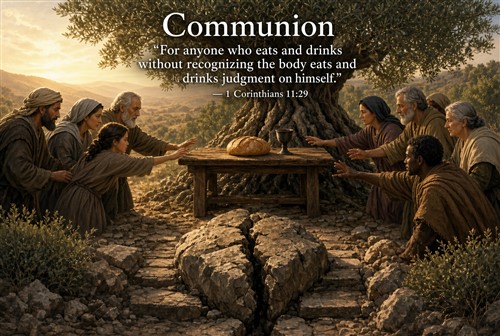
Today I am writing about communion and several issues around it that hearken back to ancient times.
Track with me as I explore the biblical issues about taking communion. It is a subject that came up this week, and I know I want to address some of those issues. Some I already know, but others are part of the deeper dive of research that I will do into those issues today.
The first thing to say about communion is that the wine and the unleavened bread have been taken for thousands of years in the Passover. In fact, the Last Supper was the Passover dinner, something a great many Christians have no inkling of. In the gospel accounts, when Jesus took the Passover Feast with His disciples, in the Luke account Jesus gave the symbolic meanings of the Passover bread and wine. (Luke 22:19-20) They are symbols, not literal, but prophetic symbolism.
Yeshua/Jesus took the unleavened bread, gave thanks and told them, “This is my body which is given to you: this do in remembrance of me.” And he took the wine and said, “This is the cup of the new covenant in my blood, which is shed for you.”
This is symbolic of Yeshua giving His body as the sacrificed Lamb, that His blood would be used as the covering once, for all, of sins.
Back to Luke’s account, in verse 21, in the course of saying these things, Jesus hands a piece of the bread to Judas saying, “But, behold, the hand of him that betrays me is with me on this table. And truly the Son of man goes as it was determined, but woe to that man by whom He is betrayed.”
The Apostle to the Gentiles, Paul warned in 1 Corinthians 11:26-28, that we are proclaiming the Lord’s death as often as we take the bread and wine, until He returns. Because of that if we take communion “in an unworthy manner” we are guilty of sinning against the body and blood of the Lord. Therefore each one of us “must examine himself before” taking communion.
Communion: Divided Table continues
Clearly Judas is the biblical example of taking communion unworthily, knowing he was next going out to betray Jesus’ location to the priests, but we ALL need to examine ourselves to reflect on whether we too are taking communion unworthily.
As Paul was clarifying what this meant, he told the Corinthian church that their communion was not legitimate because, “Now then, when you come together, it is not the Lord’s Supper you eat. For as you eat, each of you goes ahead without sharing his meal. While one remains hungry, another gets drunk. Don’t you have your own homes in which to eat and drink? Or do you despise the church of God and humiliate those who have nothing?”
And in verse 29-30 Paul pinpoints why this behavior is so unworthy: “For anyone who eats and drinks WITHOUT RECOGNIZING THE BODY” eats and drinks judgment on himself. That is why many among you are weak and sick, and a number of you have died.”
So Paul is underscoring how important this is. He is not saying that we are not recognizing the communion bread as the physical body of the LORD think that as we eat it, the wafer becomes His actual body. What Paul is saying we are not recognizing the whole congregation is the body of the Christ. All of us who are joined to Him by faith is what we fail to recognize. WE are the BODY of the Lord, that we must recognize each other as part of the Lord’s body in order to take communion legitimately, worthily.
I suspect that we examine ourselves for sins when we take communion, but don’t give a second thought about the one thing that Paul spoke about: recognizing each other as the body of Christ and treating each other like we are. Does that even come to mind as we close our eyes and examine ourselves sitting in our congregations about to take communion? How would body-life change if we did?
Now one of the issues I wanted to touch on was about it not being a requirement that a priest or pastor be present for us to take communion. I do know of dedicated believers who take communion in their homes every single day. We can examine ourselves daily and taking communion offers that ability to do so – keeping our link with the Lord renewed daily. There are no middle men required between ourselves and God in the faith of Yeshua/Jesus.
There are some who believe only a priest can give and bless communion. I suspect this is probably because they also believe in transubstantiation. I do not find this belief is actually substantiated in the Bible.
The claim is that what Jesus said about the bread and wine is literal, not symbolic. But Jesus himself notes the symbolism in the Passover meal. It was symbolic in the 2,000 years of Jews observing Passover before Yeshua came in the flesh, and it is still symbolic of the body of Christ in the earth after He ascended back into Heaven. Collectively we are His body in the earth today.
We must take notice that the Communion we take today was the Passover meal that Jesus took in the Last Supper, and the same that Jews have continued to observe over the last 3,471 years since Exodus 12:1. Most of them still do not realize what these symbols of the bread and wine mean. They think it hearkens back to what happened literally as they left Egypt and do not understand it is the prophetic symbol that looked ahead the Yeshua laying down His own body as the sacrificed lamb. In due season they will because this is the plan and purpose of God.
Already there are a million+ Messianic Jews worldwide. They are part of the body in the earth today. . .and might I say, they are a part of the body that a LOT of Christians do not recognize as part of the body of the Lord. So you can see how this is going to come into greater intensity as a separator between wheat and tares, or those taking communion unworthily.
On a personal note, being married to an Italian I have had many opportunities to attend Catholic church events with his family over the past 43 years, and I was shocked that I was not allowed to take communion like everyone else. Obviously I don’t believe that is a legitimately biblical doctrine not because I was not raised in that tradition but because I can’t find that in my Bible. God’s Word is the last word in my eyes.
Also in a major unity movement I was attached to over 25 years ago whose goal it was (and still is) to unite Christians and Messianic Jews, a huge flaw I saw with this movement was that even to this day, the Catholics that are a part of their leadership cannot take communion together with the non-Catholics in their leadership. I don’t see this as a minor issue, and I am surprised that all these years later it has not been a more recognized obstacle to unity. To be honest, I don’t expect ever to see the Catholic or Eastern Orthodox churches change their position on this dogma, so I don’t know how we can truly recognize each other as the body of the Lord the way Paul explained it in his letter.
If we cannot take communion together as the body of the Lord in the earth, how unified are we really? It is the difference in being family and being acquaintances. Instead we have levels of superiority which are not biblical.
But I have other issues with the doctrines of Catholicism, like how is it that Paul is the Apostle to the Gentiles, but the Catholic Church claims to be built on the rock of Peter in a succession line. Honestly, I think Peter would roll over in his grave at that suggestion. The New Testament never calls Peter bishop of Rome or says he founded the Roman church. Paul’s Letter to the Romans greets many people in an already-existing congregation but never once mentions Peter. Paul’s two-year stay in Rome is described in Acts 28 but again never referring to Peter.
Peter was not even the head of the Apostles in Jerusalem, but James, the brother of Jesus was. It was the tradition in subsequent generations of leadership among the congregations of Messianic Jews that the “Desposyni” who were from the familial line of Jesus’ brothers and sister that would led the oldest congregations in the Middle East. It was a respect thing, a deference they showed to those family members who were in the faith of Yeshua, Israel’s Messiah.
In 318 AD pope Silvester was paid a visit by representatives of the body of the Lord in Israel & surrounding Middle Eastern nations where Jewish believers in Yeshua had congregations. The representatives sent to Rome included several in the direct line of familial descendants of Jesus’ own family. Unfortunately Rome showed no deference to Jesus’ own family but rather feared that Rome would lose power if Christians knew there were Jewish congregational leaders who were related to His family! I know I would respect meeting Jesus 2nd cousin who led a congregation in Israel or even in Syria!
One Catholic historian states that the pope refused to acknowledge their significance or grant their request for financial assistance. That is the financial assistance that the apostle Paul set up as a precedent among the Christian churches he had oversight of. The historian reports, “Silvester curtly and decisively dismissed the claims of the Jewish Christians. He told them that the mother church was now in Rome, with the bones of the Apostle Peter, and he insisted that they accept Greek bishops to lead them.”
“Silvester backed by Constantine” decided the message of Jesus was to be “couched in Western terms by Western minds on an imperial model.”
The Catholic historian Malachi Martin goes on to write in his 1983 book, The Decline and Fall of the Roman Church: “The Jewish Christians had no place in such a church structure. They managed to survive until the first decades of the fifth century. Then, one by one, they disappear. A few individuals reconcile themselves with the Roman Church—always as individuals, never communities or whole Jewish Christian churches. Another few pass into anonymity of the new Eastern rites—Syrian, Assyrian, Greek, Armenian. But most of them die—by the sword (Roman garrisons hunted them as outlaws), by starvation (they were deprived of their small farms and could not or would not adapt themselves to life in the big cities), by the attrition of zero birthrate. By the time that the first biography of Jesus (apart from the Gospels) is published in Chinese and in China at the beginning of the seventh century, there are no more surviving Jewish Christians. The Desposyni have ceased to exist. Everywhere, the Roman pope commands respect and exercises authority.”
That paragraph is so profound to me knowing that God also said in His Word of punishing Israel by sending them into exile, but being angry with those in the nations who abused the Jews, saying in Zechariah 1:14-15 “Proclaim this word: This is what the LORD of Hosts says: ‘I am very jealous for Jerusalem and Zion, but I am fiercely angry with the nations that are secure. For I was a little angry, but they have added to the affliction.’
That is the origin point for first major split of the faith, between Jewish and Gentile believers. And what was it about? Who gets the power to dictate to the rest of the faith what to believe. That is not why the Jewish believers went to Rome, but that is how Rome interpreted their very existence – as a threat to Rome’s power.
The first major power grab of Christianity and more followed a handful of years later at Nicea. In refusing to understand the Hebraic language or roots of the faith, and of even rejecting the Messianic Jews as being a part of the body of the Lord on the earth, this put the Catholic church on a trajectory of making many errors in their doctrine and dogma.
For example, the historical evidence is stronger for Peter’s presence and death in Rome than for the claim that Peter ever served as the first bishop of the Christian church in Rome or in the later, monarchical sense of that office. Most historians accept the first point; the second is more debated.
To this day most Catholics seem to deny that Christianity is rooted in the faith God planted in the Jewish people. They have no expectations that Jews will ever recognize Jesus is Israel’s Messiah. This disregards the testimony of God Himself throughout the Bible. Communion dogma is one more of the stumbling blocks to the unity of the faith that God is calling for between Messianic Jews and Christians in the faith of Jesus. I expect these stumbling blocks will become more acute in the days ahead.
I also would like to say that I am not anti-Catholic and I never have been. However, I am against teachings that are not in line with the whole word of God. We walk a narrow path and there are plenty of places along the path to fall into the ditch of errors. The whole Word of God is necessary. The Holy Spirit gives understanding of the Scriptures by opening our eyes and revealing what is meant. We must place our beliefs in what the whole Bible says. That is necessary. If any denomination structures claims what the Word of God does not support, this is not to be ignored.
In Romans 11:8-9 speaking of Israel “as it is written: “God gave them a spirit of stupor, eyes that could not see, and ears that could not hear, to this very day.” And David says: “May their table (trápeza) become a snare and a trap, a stumbling block and retribution to them.”
It makes me wonder if the same may not be said about the Roman decision to cut the Jewish believers out of the ‘communion’ to be had at the Catholic ‘trápeza’ banqueting table.
It would not surprise me. Christians have failed in all the same ways Israel had failed before them. I have lately begun to think that is exactly what God is trying to get both Jews and Gentiles to see about ourselves, so the ones who do, can enter into unity together with Him; and the ones who can’t will fall by the wayside.
You May Also Like